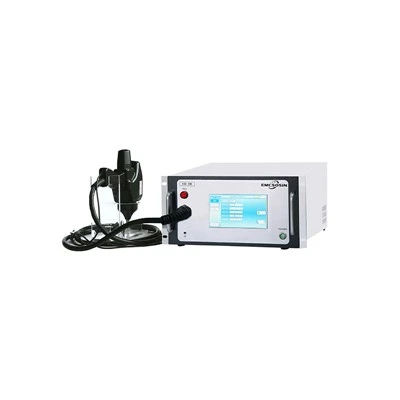
01 | Product Positioning: The EFT-S6 Reproduces Switching Transients, Not Lightning Surges
Key takeaways first: The EFT-S6 is an EFT/burst generator from EMCSOSIN for equipment under test (EUT) rated up to 16 A single-phase, designed to IEC 61000-4-4:2012 and GB/T 17626.4-2018. Confirm two things before ordering: whether the EUT is single-phase powered, and whether its I/O ports need testing - if so, the capacitive coupling clamp is mandatory, not optional.
A significant share of failures in everyday electrical equipment can be traced back to switching-transient pulse interference.
Transients from switching inductive loads off, or from relay contact bounce, interfere with other electrical and electronic equipment in the same circuit. This type of interference has four characteristics: high voltage amplitude, steep rising edge, high repetition rate, and low energy per pulse.
The role of the EMCSOSIN EFT-S6 EFT/burst generator is to reproduce these real-world conditions precisely in the laboratory.
The failure mechanism comes first, because it drives instrument selection.
A single pulse carries little energy, so it is usually not enough to break down a device outright. But the pulses arrive in bursts: dense narrow pulses keep charging the junction capacitance of semiconductor devices, and once the accumulated charge reaches a certain level, circuits or equipment start to malfunction.
The visible symptoms: erratic equipment operation, program corruption, communication packet loss, and watchdog resets.
This is also the fundamental difference from surge testing. Surge (IEC 61000-4-5) tests withstand capability against high-energy impulses, with a 1.2/50 μs waveform; EFT tests filtering, grounding, and software fault tolerance, with a 5/50 ns waveform. The two cannot substitute for each other, and they do not share one generator.
02 | The Applicable Standard: The Current Edition Is IEC 61000-4-4:2012, Not a 2018 Edition
This instrument is developed to the current editions of IEC 61000-4-4 and GB/T 17626.4, covering immunity tests on four port types: power, signal, control, and ground.
It uniformly reproduces the interference environment used to assess whether the EUT operates reliably under EFT disturbance.
The edition number must be written out in full - otherwise the statement above is meaningless.
GB/T 17626.4-2018 is an identical adoption (IDT) of IEC 61000-4-4:2012, Edition 3.0, published on 2012-04-30. The "2018" in the Chinese national standard is its publication year (published 2018-06-07, effective 2019-01-01), not the year of the corresponding international edition.
Under the IEC's current status, Edition 3.0 remains the valid edition, with a stability period through 2026, while Edition 4 is still at the committee-draft stage. The "IEC 61000-4-4:2018 (current)" sometimes quoted on the market does not exist.
Therefore, writing only "complies with IEC 61000-4-4" in a test plan or purchase contract is imprecise. It must read "complies with IEC 61000-4-4:2012" or "complies with GB/T 17626.4-2018". Calibration and setup requirements differ between editions, and test reports cannot be borrowed across them.
03 | Generator Characteristics: Calibrate at Both 50 Ω and 1000 Ω - One Load Alone Is Incomplete
The standard defines an explicit set of requirements for the generator itself; check them item by item during selection.
Single-pulse waveform: rise time 5 ns ±30%, pulse width 50 ns ±30%, calibrated into a 50 Ω load.
Peak output voltage: 0.5 × the voltage setting into a 50 Ω load (tolerance ±10%); 0.95 × the setting into 1000 Ω (tolerance ±20%). At the same setting, the readings under the two loads differ by nearly a factor of two - this is normal, not a fault.
Repetition frequency: only two settings, 5 kHz and 100 kHz, each with a ±20% tolerance.
Burst timing parameters: at 5 kHz, each burst lasts 15 ms ±20%; at 100 kHz, 0.75 ms ±20%; burst repetition period 300 ms ±20%.
The pulse-width tolerance under the high-impedance load is specified separately. Into 1000 Ω, the nominal width is 50 ns with a tolerance of −15 ns to +100 ns, i.e. 35 ns to 150 ns. That upper limit is three times wider than at 50 Ω; applying the 50 Ω tolerance to high-impedance measurements leads to false pass/fail judgments.
DC blocking capacitor: (10 ± 2) nF - an item that is easy to miss during calibration.
All six calibration parameters (repetition frequency, burst period, burst duration, peak pulse voltage, rise time, and pulse width) must be verified at both 50 Ω and 1000 Ω loads. This is required by the CNAS application notes for the EMC testing field.
For an instrument calibrated on the 50 Ω path only, the calibration report is incomplete.
04 | Port Coverage: Power Ports via CDN, Signal and Control Ports via Capacitive Coupling Clamp
The standard defines two coupling devices with a clear division of labor; they are not interchangeable.
The coupling/decoupling network (CDN) is used for power-port tests. The pulses are coupled through 33 nF capacitors to each line conductor, the neutral, and the protective earth simultaneously - common-mode injection. The EFT-S6 has a single-phase three-line CDN built in, rated 16 A.
The capacitive coupling clamp is used for I/O and communication ports. These are two independent paths; select by port type at test time.
One caution: in most quotations the coupling clamp is listed as an optional accessory. If the EUT has signal, sensor, or communication cables to be tested for EFT, the clamp must be included in the purchase - otherwise only the power port can be tested.
Test levels are listed separately by port type.
Power and protective-earth ports: 0.5 / 1 / 2 / 4 kV; I/O signal and control ports: 0.25 / 0.5 / 1 / 2 kV - exactly half, because the two paths present different load impedances.
The severity level is selected by the product standard, not by the basic standard.
05 | Intended Applications: Two Categories by Port Requirements - Look Beyond Voltage
Target scenarios for the EFT-S6 single-phase 6 kV burst generator are best divided by the ports to be tested - more accurate than dividing by industry.
Category 1: power-port testing primarily. Small appliances, lighting, adapters, power boards, and finished smart-home and consumer electronics devices and modules. These EUTs are usually rated 16 A or below, so the built-in single-phase three-line CDN works directly, with no external network needed.
Category 2: both power ports and signal ports. Industrial instruments, sensors, and smart-home and consumer products with communication ports. In addition to the main unit, these need the capacitive coupling clamp - otherwise the I/O ports cannot be tested.
06 | Lightweight, Easy to Use, Cost-Effective: The Engineering Rationale Behind Each Claim
These three words are often used loosely in instrument selection; here is the physical basis behind each.
Lightweight - the built-in CDN. The EFT-S6 integrates the single-phase three-line 16 A coupling/decoupling network into the main unit, eliminating the external CDN and its entire set of wiring. One fewer enclosure, and one fewer bonding point prone to error.
Overall dimensions are 446 mm × 400 mm × 175 mm (L × W × H) - a benchtop format that fits an ordinary laboratory bench, with no rack required.
For R&D departments and small laboratories short on space, this is a real saving.
Ease of use - built-in level parameters and programmability. Standard severity levels, such as 4 kV and 2 kV, are pre-loaded and recalled directly, with no manual conversion of the output voltage between 50 Ω and 1000 Ω loads.
A 7-inch touchscreen handles all settings and supports programmable operation for one-touch execution of preset sequences.
RS232 / RJ45 interfaces connect to a host PC for remote control and test report output, eliminating manual logging.
Phase synchronization covers 0–359°, with an asynchronous mode available, so phase-synchronized power-port tests can be run directly.
Cost-effectiveness - range matching, not spec stacking. Among target customers, the vast majority of EUTs are single-phase powered at up to 16 A, exactly what the built-in network of the EFT-S6 single-phase 6 kV burst generator covers - there is no need to step up to the three-phase five-line T series.
The 6 kV maximum output leaves a 1.5× margin over the 4 kV highest standard power-port level, for design-margin probing and failure-threshold search.
To be clear: this margin is not a standard requirement. Compliance testing recognizes only up to the 4 kV level; anything above it is a development-stage self-test method and cannot be written into a certification report.
07 | Test Setup: The Three Points That Most Often Invalidate Results
A compliant instrument does not guarantee valid test results. The following three points are the most frequent failure spots.
Reference ground plane. The CNAS application notes specify: for copper or aluminum, plate thickness ≥ 0.25 mm; for other metallic materials, thickness ≥ 0.65 mm; minimum area 1 m × 1 m; each edge extending at least 0.1 m beyond the combined dimensions of the instrument and the EUT; and the plane connected to the laboratory protective earth.
Note that these are two thickness tiers by material - not a uniform 0.65 mm.
Bonding. The connection between the CDN and the reference ground plane must use wide, short bonding straps - not thin wires. The stray inductance of thin wires changes the pulse waveform, so measured results deviate from the true values.
Cable dressing. Place the EUT on 0.1 m high insulating supports, and neither bundle nor coil the cables. Once a cable is coiled, the coupling impedance changes, and results become either too lenient or too strict.
In addition, the test duration for each port and each polarity must be no less than 1 minute, in both positive and negative polarity.
08 | EFT-S6 Single-Phase 6 kV Burst Generator - Technical Specifications
|
Technical Parameter |
Specification |
|
Output voltage range |
200–5000 V (±10%) |
|
Polarity |
Positive (+), negative (−), +/− alternation, −/+ alternation |
|
Source impedance |
50 Ω |
|
Output waveform - 50 Ω load |
Rise time 5 ns (±30%), duration 50 ns (±30%) |
|
Output waveform - 1000 Ω load |
Rise time 5 ns (±30%), duration 35 ns–150 ns |
|
Phase |
Asynchronous (random angle); Synchronized (0–359°, 1° steps); Auto (0°, 90°, 180°, 270° in sequence) |
|
Pulse count |
1–255 |
|
Pulse frequency |
0.001–1000.000 kHz |
|
Pulse period |
0.01–300.00 s |
|
Test time |
1–9999 s |
|
Coupling/decoupling network |
Built-in single-phase three-line (AC 220 V/16 A, DC 60 V/16 A) ※1: The load capacity of the CDN is subject to the technical agreement |
|
General Parameter |
Specification |
|
Display |
7.0-inch touchscreen |
|
Power supply |
AC 220 V ±10%, 50/60 Hz |
|
Fuse |
3 A |
|
Maximum power consumption |
500 W |
|
Ambient temperature |
15 °C – 35 °C |
|
Relative humidity |
30% – 60% |
|
Atmospheric pressure |
86 kPa – 106 kPa |
|
Dimensions |
446 × 400 × 175 mm (L × W × H) |
09 | Two Boundaries to Confirm Before Ordering
Two limitations must be confirmed before placing the order; otherwise you may end up with a main unit that cannot run the tests you need.
First, single-phase vs. three-phase. The EFT-S6 single-phase 6 kV burst generator has a built-in single-phase three-line CDN and can only test single-phase EUTs. Three-phase equipment requires the T series, or an external three-phase five-line CDN.
Second, ports and accessories. As long as the EUT has signal, control, or communication ports to be evaluated, the capacitive coupling clamp is mandatory - not an option.
Check these two points against the EUT's power supply form and port list before discussing configuration.
The EMCSOSIN EFT-S6 single-phase 6 kV burst generator is positioned for teams working with single-phase equipment rated up to 16 A, whose primary needs are R&D pre-compliance testing and factory inspection - a compact solution for direct GB/T 17626.4-2018 and IEC 61000-4-4:2012 compliance testing.
Its margin lies in the voltage range and programmability; its boundaries lie in the single-phase network and the coupling clamp accessory. When selecting, verify against the EUT port list - more reliable than matching by industry name.
For the specific values mentioned in this article, the equipment nameplate, the factory inspection report, and the original standards text take precedence.