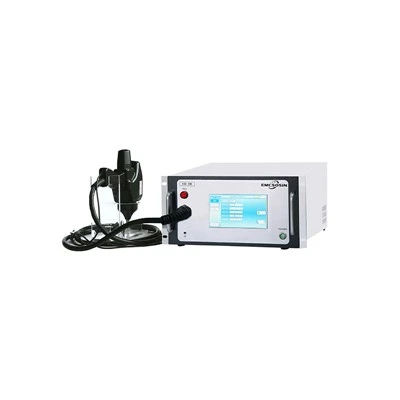
The Suoxin voltage dip generator family is not a "one unit for everything" product. It is split into two lines according to the current rating and supply type of the equipment under test: the Basic series (VDT S/T range, ≤16 A AC) focuses on compliance screening and production-line quality control, while the High-Power series (VDT T100/T200 three-phase high-current, VDT DC for DC supplies, VDT T10D AC/DC all-in-one) targets complex fault-condition reproduction above 16 A and on DC ports.
Choosing between the two lines comes down to three questions: does the rated current exceed 16 A per phase? Is the supply port AC or DC? Do you need high-fidelity dynamic simulation?
Most buying guides treat the voltage dip generator as a single product, but real demand falls into two categories. The table below maps the true boundaries of the two Suoxin product lines - within one family, four groups coexist: AC ≤16 A, DC, >16 A high-power, and AC/DC all-in-one. Just a few years ago, high current and DC were still blank spots.

This table is itself equipment-level evidence of an industry shift: test targets are moving from conventional AC equipment toward DC ports and high-power, high-voltage equipment. The two lines are broken down below, with concrete model numbers and recommendations.
The Basic Series: the Workhorse for ≤16 A AC Compliance
Models & standards: the Basic series = VDT S10 (single-phase 10 A), S20 (single-phase 20 A), T10 (three-phase 10 A), T20 (three-phase 20 A). The whole family meets GB/T 17626.11 and IEC 61000-4-11 (the GB/T standard is an identical adoption / IDT).
Scope: only 50/60 Hz AC equipment with a rated input current ≤16 A per phase - beyond 16 A it does not apply (move to the High-Power series + 4-34).
What it solves: volume testing, stability, ease of use. Core tasks = compliance screening / batch production-line QC / preliminary R&D verification; typical targets = general electronic & electrical equipment, automotive ECU production-line testing and other takt-time-sensitive scenarios; key advantages = controllable cost, high reliability, low operating threshold, matches production-line takt.
Hard specifications (pass thresholds, not "faster is better"): rise/fall time 1–5 μs on a 100 Ω resistive load; phase error <±10°, with switching at 0°/90°/180°/270° or a freely selected angle; preferred test levels 0% / 40% / 70% (plus the 80% voltage variation), consistent with Tables 1 and 2 of the standard.
Don't get the levels backwards: a "70% dip" = 70% residual voltage (a 30% drop); a 40% dip = 40% residual (a 60% drop); 0% = complete interruption. Swap the numerator and denominator and you are off by two test levels.
Always cite the edition: IEC 61000-4-11 is now at :2020 (Edition 3.0), and the current GB/T 17626.11-2020 is the identical adoption. Writing "compliant" without an edition number = an invalid conclusion.
Recommendation: for single-phase equipment choose the VDT S10 / S20; for three-phase equipment choose the VDT T10 / T20.
The High-Power Line Crosses the High-Current Threshold: VDT T100/T200 and IEC 61000-4-34
Scope: for equipment with a rated input >16 A per phase, the basic standard is no longer 4-11 but IEC 61000-4-34 (corresponding GB/T 17626.34). Many buying guides miss this line entirely - and the cost of missing it is real: testing high-current equipment directly against 4-11 and issuing the report can be ruled an inapplicable test method on site or during certification.
Models & standards: the Suoxin VDT T100 (three-phase 100 A) and T200 (three-phase 200 A) explicitly cover 61000-4-11/34 and 17626.11/34, precisely filling this high-power, high-voltage line.
What it solves: high current, high fidelity, and true reproduction of real fault conditions - not hand-turned potentiometer approximations.
Typical targets & advantages: typical targets = PV & energy storage, high-power charging infrastructure, industrial motors, transformer-type loads, wind-turbine low-voltage ride-through (LVRT); key advantages = high current capacity + waveform fidelity + independent per-phase control, stable reproduction instead of hand tuning; technical maturity = power-electronics-based (DSP + FPGA dynamic simulation) continuously evolving, keeping pace with the leading edge of the standards.
Check for AMD2: 4-34 received its AMD2 amendment in 2025 (consolidated Edition 1.2, published 2025-08-07). High-power equipment selection must reference this edition; older generators may not cover the newly added clauses.
Recommendation: for >16 A industrial and new-energy high-power equipment, go straight to the VDT T100 / T200 - only a report issued against 4-34 will hold up.
DC Dips: VDT DC and IEC 61000-4-29:2026
Scope: DC supply ports do not use 4-11 but IEC 61000-4-29 (corresponding GB/T 17626.29). This is the most direct evidence of the downstream industry upgrade - test targets are moving from AC to DC.
Typical targets: EV charging piles, PV inverters, energy-storage converters, and the DC busbars of 800 V vehicle architectures all fall under this standard. Whoever still tests only AC cannot take on the new industry's orders.
Models & standards: the Suoxin VDT DC voltage dip generator meets 61000-4-29 and GB/T 17626.29, covering 40% / 70% dips, 0% interruptions and 80% / 120% voltage variations, for both high- and low-impedance interruption conditions.
Cite the new edition: 61000-4-29 has just been revised as :2026 Edition 2.0 (published 2026-07-30, replacing the 2000 first edition), which hard-codes the generator's maximum output voltage, the current limiting for low-impedance interruptions, and a verification uncertainty of ±2%. For DC port testing, specify this new edition.
Recommendation: for any equipment with a DC supply port (charging piles, PV/storage converters, 800 V vehicles), choose the VDT DC and test against 4-29.
AC/DC All-in-One and High-Fidelity Simulation: VDT T10D
The high-fidelity trend: real grid faults are mostly single-phase or phase-to-phase, not a symmetric three-phase drop. 61000-4-11 requires per-phase testing across all six L-N and L-L combinations - miss one and you have a missed test. This is exactly what "moving from static simulation to high-fidelity simulation" means: only with microsecond-class edges, settable phase angles and complete combinations can you approach a real fault.
Models & standards: the Suoxin VDT T10D (three-phase 10 A) covers 61000-4-11/29 and 17626.11/29, combining AC sag + DC dip capability in one unit and eliminating equipment changeover and rewiring.
Dynamic simulation capability: supports programmable orchestration of disturbance sequences with multiple phases, depths and durations - stable, repeatable reproduction rather than hand-turned potentiometers.
Recommendation: for R&D scenarios that need compliance at ≤16 A AC and DC port coverage, or high-fidelity dynamic simulation, choose the VDT T10D - one unit does the work of two.
Model Recommendations by Scenario