According to TrendForce, global installations of high-voltage systems above 550 V grew 38% year-on-year in Q4 2025, with penetration expanding to 14%. In China, more than 30 automakers have already deployed 800V high-voltage electrical systems, and prices of 800V models have dropped from over RMB 200,000 into the RMB 100,000–150,000 range. The 800V architecture is no longer a badge reserved for a few flagship models - it is becoming the mainstream technology route of the new energy vehicle market.
Notably, only when the battery, electric drive, electronic control, A/C compressor, and even the high-voltage harnesses and connectors are all natively designed for the 800V-and-above withstand class can testing truly apply higher and more complete electrical stress to the device under test. If components are merely adapted from a 400V platform, the test severity will fall short of the real 800V operating conditions.
GB/T 37133-2025, High-Voltage Connection Systems for Electric Vehicles, has raised the withstand voltage requirement to 1500 V and explicitly requires 800V systems to meet a 3 mm electrical clearance and an 11 mm creepage distance. Withstand voltage testing is no longer a matter of applying high voltage once and calling it done - it must be combined with insulation coordination, current-carrying temperature rise, and retests after mechanical shock, verifying the complete high-voltage connection system over multiple rounds. This means the voltage margin and continuous-operation capability of impulse withstand equipment are no longer optional extras; they are hard thresholds.

Upgrading from 400V to 800V
When a 400V high-voltage platform is upgraded to 800V, many requirements must be upgraded along with it. For cables on a 400V platform, the impulse withstand target sits at the 8 kV class. After upgrading to 800V, the maximum working voltage U_max rises, the insulation coordination class must move up one level, and the target rises to 10 kV accordingly. Continuing to use equipment selected in the 400V era will no longer be sufficient - upgrading to a higher-power impulse withstand voltage tester becomes a necessity.
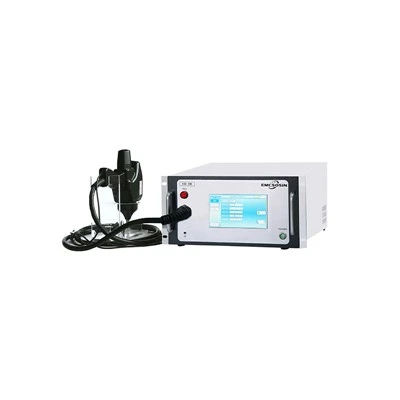
The EMCSOSIN WVT 255L offers an output range of 0.5–50 kV, covering the 8 kV to 10 kV target range of both the 400V and 800V platforms with ample margin. A single instrument covers the requirements of both platforms.
Standards Comparison at the Cable and Connection System Level
|
Standard / Item |
Applicable To |
400V Platform Requirement |
800V Platform Requirement |
Upgrade Change |
|
GB/T 37133-2025 Basic insulation |
Cables and connection systems |
2U + 1000 V (U = working voltage) |
2U + 1000 V, with U raised |
Formula unchanged; test voltage target rises with U |
|
GB/T 37133-2025 Reinforced insulation |
Cables and connection systems |
2U + 3250 V (U = working voltage) |
2U + 1000 V, with U raised |
Formula unchanged; test voltage target rises with U |
|
QC/T 1037 Cable check voltage |
High-voltage cables |
AC 600 V / DC 900 V; System: 8 kV / 1 min |
AC 900 V / DC 1500 V system: 10 kV / 1 min |
Absolute voltage class raised by 2 kV |
GB/T 37133-2025: the formula rises with U; QC/T 1037: steps up from the 8 kV class to the 10 kV class.
Withstand Voltage Class Comparison at the Vehicle / Component Insulation Level
|
Test Level |
400V System Typical Requirement |
800V Platform Typical Requirement |
Upgrade Feature |
|
Main insulation withstand |
≥ 3 kVAC class |
≥ 6 kVAC |
Step increase |
|
Critical areas such as battery pack HV interfaces |
Routine withstand requirement |
≥ 10 kVAC transient withstand |
Additional tightening for critical areas |
|
Critical areas such as battery pack HV interfaces |
- |
≥ 10 kVAC transient withstand |
Covered by 0.5–50 kV output |
At the vehicle/component insulation level, the same step change appears: main insulation on an 800V platform jumps from the ≥ 3 kVAC class to ≥ 6 kVAC, and critical areas even require ≥ 10 kVAC transient withstand capability.
Note: The kVAC values cited in this article are power-frequency (AC) withstand test requirements. Impulse withstand testing uses the 1.2/50 μs lightning impulse waveform, and the test target voltage must be converted according to the applicable product standard - the two cannot be equated directly.
WVT 255L Output Range vs. 800V Upgrade Requirements
|
Test Scenario |
400V Requirement |
800V Requirement |
WVT 255L Output Range |
Coverage Conclusion |
|
HV cable check voltage |
8 kV / 1 min |
10 kV / 1 min |
0.5–50 kV |
Fully covers the 8 kV → 10 kV step |
|
Vehicle / component main insulation withstand |
≥ 3 kVAC class |
≥ 6 kVAC |
0.5–50 kV |
Covers the 6 kVAC class |
|
Critical areas such as battery pack HV interfaces |
- |
≥ 10 kVAC transient withstand |
0.5–50 kV |
Covers the 10 kVAC class |
Instrument capability is not the bottleneck. What the 800V upgrade really changes is the setpoint - "how many kV to apply" - and the WVT 255L's 0.5–50 kV voltage window easily carries that change.
Key Selection Criteria for an Impulse Withstand Voltage Tester
50 kV-class output capability: peak voltage and voltage hold under load;
Repetition rate / test cadence at 50 kV: continuous operation without derating;
Thermal stability: temperature rise of key components and waveform consistency after continuous operation;
Voltage drop and waveform drift: stability of peak value / front time / time to half value under continuous output;
Charging / energy-storage unit lifetime and cooling strategy: not "a few shots, then a rest";
Safety interlocks and HV protection: safety redundancy for long-time high-voltage operation.
Key Specifications of the WVT 255L
|
Parameter |
Specification |
|
Model |
WVT 255L |
|
Maximum voltage class |
50 kV |
|
Internal resistance module |
500 Ω |
|
Voltage waveform |
1.2 μs ±30% / 50 μs ±20% |
|
Output voltage range |
0.5 kV – 50 kV ±3% |
|
Output impedance |
500 Ω (±10%), customizable |
|
Interval time |
20 – 9999 s |
|
Number of tests |
1 – 9999 counts |
|
Power supply |
AC 380 V ±10%, 50/60 Hz |
Two High-Demand Application Scenarios
R&D Validation for 800V and Higher Platforms
The high voltage class covers spikes and safety factors, while continuous-operation capability supports multi-round tasks such as retesting after mechanical shock and insulation coordination review. Samples are few but operating conditions are many - once the equipment goes down, the entire test schedule is disrupted.
High-Intensity Duty in Laboratories and Production Lines
The production line does not accept equipment that can only work for short periods in demo mode. Many instruments on the market look impressive on paper, but at high voltage settings they are constrained by energy storage, charging, heat dissipation, and protection strategies, and can only run briefly. What really determines production-line efficiency is whether the tester can fire continuously and stably at a 50 kV setting.
Note: The "long-time, uninterrupted 50 kV testing" described in this article refers to a capability of the instrument - the ability to deliver continuous pulse output and run thermally stable at a 50 kV voltage setting, without derating or shutdown caused by heat accumulation, charging-unit overheating, or protection strategies. It does not suggest applying 50 kV continuously to the device under test; the withstand test lasts exactly as long as the applicable standard requires.