

Electrostatic protection is a must-know! HBM vs. MM: "How to test the different "Electric Shocks" between Human Body and Machines?
In today's world where electronic products are everywhere, electrostatic discharge (ESD) is like an invisible "killer" that can cause fatal damage to sensitive electronic components at any time. To evaluate and improve the ESD protection capability (ESD Immunity) of products, international standards organizations have defined multiple ESD test models. Among them, the Human Body Model (HBM) and the Machine Model (MM) are the two most commonly used and crucial ones.
As a professional EMC equipment supplier, Shanghai Sosin Electronics Co., Ltd fully understands that distinguishing between these two models is essential for selecting appropriate testing equipment and developing effective protection strategies. Today, we will take a detailed look at HBM and MM.
1. Simulation scenarios: Who is "discharging"?
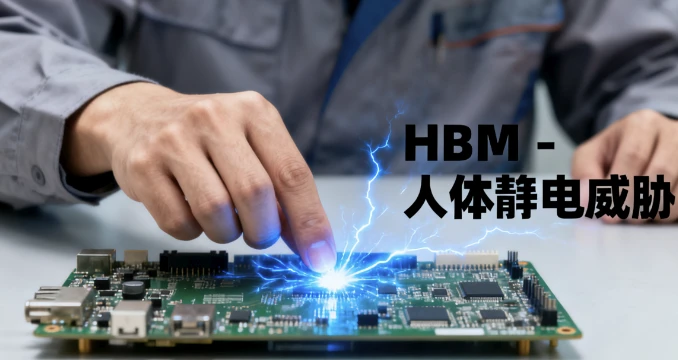
- HBM (Human Body Model):
Simulation object: The discharge process when a charged human body contacts electronic devices or components. This is the most common source of ESD events. For example, when an operator's hand touches a device interface or PCB pin.
Key features: It simulates the discharge from a human body (approximately 100pF capacitance) through a certain resistance (approximately 1.5kΩ) to the DUT/EUT. The discharge current waveform is relatively slow (rise time of about 2-10ns, duration of about 100-200ns), with relatively low energy but is more common.
- MM (Machine Model):
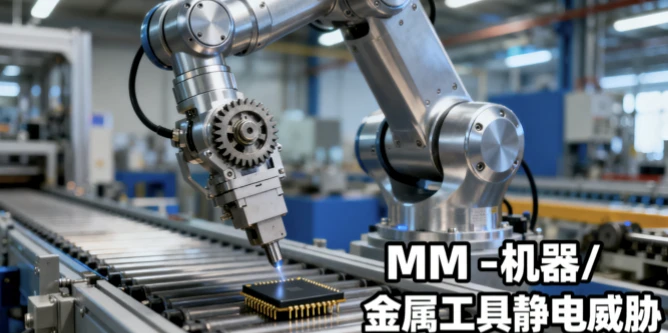
Simulation object: The discharge process when a metal device or tool that is electrified comes into contact with electronic equipment or components. For example, metal fixtures, mechanical/robotic arms, or live tools (such as an ungrounded soldering iron tip) on an automated production lines that come into contact with components.
Key features: It simulates the discharge of a low-impedance metallic object (with a capacitance of approximately 200pF) to the test subject through an extremely small or even negligible resistance (<10Ω). The discharge current waveform is very fast and has a high peak current (rise time <1ns, short duration but with a significant current spike), with energy concentrated in an instant and greater destructive power. MM is considered a more severe test than HBM.
2. Key Differences Comparison: HBM vs. MM
|
Features |
HBM |
MM |
|
Model source |
human body electrostatic discharge |
Electrostatic discharge of metal equipment/tools |
|
Equivalent circuit |
100pF capacitance + 1.5kΩ resistor |
200pF capacitance + <10Ω (close to 0Ω) resistor |
|
Discharge features |
The current is relatively small and slow, with low but generally available energy. |
The peak current is extremely high and fast, with concentrated energy in an instant |
|
Severity |
Relatively mild |
More severe |
|
Main threats |
Operator contact |
Automated production and testing equipment contact |
|
Common standards |
ANSI/ESDA/JEDEC JS-001, IEC 61000-4-2 (indirectly related) |
JESD22-A115 (historical standards, reduced application) / ANSI/ESDA/JEDEC JS-002 (replace MM) / Some industry/enterprise standards are still in use |
|
Application focus |
Reliability assessment of consumer electronics, communication equipment, and general components |
Devices that are extremely sensitive to ESD (such as certain MOSFETs), specific industrial/automotive electronics, and production process control |
3. Application scenario: Why is it necessary to distinguish between tests?
Understanding the differences between HBM and MM directly determines the focus of testing strategies and the protection design:
- The wide application of HBM testing:
Component-level testing: The ESD (electrostatic discharge) resistance levels (such as Class 1A, 1B, 1C, 2, 3A, 3B) of semiconductor devices like chips, diodes, and transistors are mainly based on the HBM standard (such as JS-001). This is the foundation for ensuring the survivability of components during manufacturing, assembly, transportation, and usage (human contact).
Board-level/System-level Reference: While IEC 61000-4-2 remains the gold standard for system-level ESD immunity testing (simulating air/contact discharges that is closer to the human body), the HBM test results still have significant reference value for understanding device interfaces and the weak points of key components.
Consumer electronics and communication devices: The main ESD threat faced by these products comes from human contact. HBM testing is the key to evaluating their inherent reliability.
- The specific value of MM testing:
- High-sensitivity Component Verification: For certain components that are extremely sensitive to ESD (such as some power MOSFETs and specific RF components), even if they pass the HBM test, they may still be "instantly killed" by metal tools during the production process. The MM test (or more modern CDM, IEC 61000-4-2) is an important means to verify whether they can withstand the harsh tests of the automated production environment.
- Specific industries/harsh environments: In highly automated automotive electronics and industrial control production lines, or in fields with extremely high reliability requirements (such as aerospace), evaluating the equipment's resistance to metal source ESD (MM or CDM) is an essential step.
- Production process control: Understanding the MM threat enables the implementation of stricter ESD protection measures on production lines, such as grounding of tools, the use of ion fans, etc.
4. EMCSOSIN: Your ESD Testing Solution Partner
Facing the complex ESD protection challenges and diverse testing requirements (including HBM, MM, CDM, IEC 61000-4-2, etc.), choosing reliable, accurate, and standard-compliant testing equipment is the first step to success.
Shanghai Sosin Electronics Co., Ltd specializes in the field of EMC testing equipment and provides:
- Professional ESD Simulator: Covering a full range of solutions from component-level HBM/MM/CDM testing to system-level IEC/EN 61000-4-2 standard testing.
- High Precision and Reliability: The equipment strictly complies with international standards such as ANSI/ESDA/JEDEC and IEC, ensuring accurate, reproducible, and comparable test results.
- Extensive application expertise: Our technical team has deep industry-specific knowledge of ESD testing requirements and pain points across sectors including consumer electronics, automotive electronics, industrial control, and semiconductors, providing professional guidance for equipment selection and application support.
- Comprehensive local services: From pre-sales consultation, installation training, after-sales maintenance, we provide full support throughout the process.

5. Conclusion
HBM and MM, as the two fundamental models for electrostatic discharge testing, respectively simulate two completely different discharge threats: the human body and metal machines. A clear understanding of the differences, characteristics, and application scenarios is crucial for conducting effective ESD protection design, accurate assessment of product reliability, and optimization of production processes.
Shanghai Sosin Electronics Co., Ltd is committed to providing customers with advanced EMC testing technology and equipment, helping you calmly cope with various ESD challenges including HBM and MM, and enhancing product quality and market competitiveness!
Call to Action (CTA):
Want to learn more about the ESD test solution tailored for your product?
Need HBM/MM testing equipment selection suggestions?
Concerned about ESD protection challenges in the production process?...
Contact the EMCSOSIN technical experts now!:)


