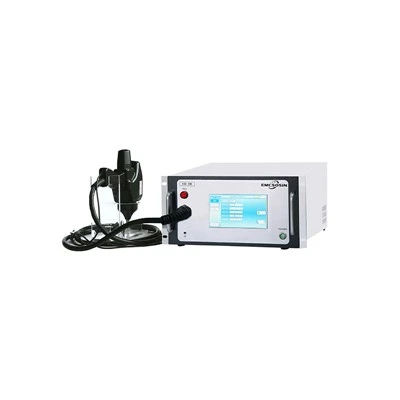

If you’ve ever been around ESD testing—whether you’re a product engineer, EMC lab tech, or someone who’s just curious about how electronics get validated—you’ve probably seen an ESD test gun in action. You know, that sleek, handheld device with a sharp metal tip that zaps a prototype and makes it flicker, reset, or even shut down entirely. But have you ever stopped to wonder what’s actually happening when that zing hits? Like, what’s the pulse shape that comes out of the gun? I’ve been around ESD test guns for years—since my team started building these things at our lab—and I’m here to break it down, no overly technical jargon (okay, maybe a little, but I’ll keep it real).
First off, let’s cut through the confusion. A lot of people think all ESD pulses are the same, but nope. The pulse shape depends entirely on the type of ESD event we’re simulating, and that’s where standards like HBM (Human Body Model) and MM (Machine Model) come in. These are the two big ones everyone in EMC lives by, and they’re exactly what our HBM MM ESD Immunity Tester ESD 8K is designed to handle. I’ve used that exact model hundreds of times in our lab, and it’s never let us down when we need consistent, reliable pulses for testing.
Let’s start with HBM because that’s the most common. Think about the last time you walked across carpet in socks and touched a doorknob—that tiny spark? That’s HBM ESD. It’s the static electricity built up on your body, charged up to several thousand volts, and discharged through a small gap. The pulse shape for HBM is pretty specific, and it’s not just a random spike. From the first millisecond, it’s a fast-rise peak that hits its maximum voltage in like 1 nanosecond (1 billionth of a second—faster than you can blink), then it decays over time. Wait, let’s get into the numbers because that’s where the science matters. For standard HBM, the peak current is usually around 1.35 A when the voltage is 8kV, and the pulse has a rise time of 0.7 to 1 ns. The decay time is about 150 ns—so it’s over in the blink of an electron, but that’s exactly why it’s so damaging. A fast rise time means high-frequency energy can seep into tiny gaps in circuits, messing with semiconductors that can’t handle sudden voltage surges.
Now MM—Machine Model. That’s the ESD you get from a tool or a machine that’s charged up, not a human. Like if a soldering iron or a metal fixture rubs against a component and zaps it. MM pulses are different because they have a lower resistance path (the machine is more conductive than skin), so the rise time is even faster—like 0.1 to 0.2 ns, way quicker than HBM. The peak current is also higher; for a 20kV MM pulse, you’re looking at roughly 26 A. That’s a lot of current in a super short time, which is why MM events are especially bad for small surface-mount components. Our 20kV ESD Gun is perfect for MM testing when you need a little more oomph, and we’ve also got a 30kV ESD Gun for even higher voltage needs—whatever your test requires.
Wait, I should clear up one thing: people often mix up voltage and current here. The ESD test gun sets the voltage, right? So when you dial in 8kV, that’s the voltage across the discharge gap. The current is what actually does the damage, and it’s tied to the pulse shape. If the pulse was slow, like taking 10 ms to reach peak, it wouldn’t be nearly as harmful. But the fast rise is the key. I’ve seen this firsthand in our lab—we tested a tiny microcontroller with both a slow pulse and an HBM-like pulse, and only the fast one made it lock up. That’s because the fast pulse couples into the component’s internal circuitry before the protection diodes can kick in.
Now, let’s talk about how the ESD gun generates this specific pulse. It’s not magic—just a circuit. The gun has a capacitor that gets charged up to your set voltage (say, 15kV), then a switch (usually a spark gap or a solid-state switch) that fires to discharge the capacitor through a resistor and the test tip. The resistor is what sets the pulse shape. For HBM, that’s a 1500 ohm resistor (to mimic the resistance of human skin), and for MM, it’s a lower resistance—like 10 ohms, because a tool has much less resistance than skin. That’s why MM pulses are faster and have higher current, like I mentioned earlier. The capacitor value also matters: HBM uses a 100pF capacitor (matches the capacitance of a charged human body), MM uses a 200pF capacitor (matches a metal machine part). So it’s all about matching those components to get that exact pulse shape every single time.
But it’s not just HBM and MM. There’s also Contact Mode vs Air Mode, which changes how the pulse is delivered. Contact Mode is when the gun tip touches the component directly—this gives a more consistent pulse because the gap is zero, so you avoid the variable resistance of an air spark. Air Mode is when you hold the tip a tiny distance away (usually 10mm) and the spark jumps that gap, which simulates the random sparks you get when walking across carpet. I prefer Contact Mode for repetitive testing because the pulse is way more consistent, but Air Mode is necessary for some real-world scenarios. Our ESD Test Bench is set up for both modes, so we can switch between them in seconds without fumbling with wires or settings.
A common question I get from new engineers is: why does the pulse shape matter so much? If you just need to see if a component breaks, can’t you just crank up the voltage? No way. If you use a wrong pulse shape, you might test a component that actually passes real-world HBM but fails your test because you used an MM pulse by mistake. Or you might overtest a component that’s only rated for HBM, wasting time and money. I’ve seen this happen—one client came to us because their new product kept failing ESD tests, and it turned out their old gun was generating a pulse that was twice as long as the standard. Once they switched to our HBM MM ESD Immunity Tester ESD 8K, the failures stopped because they were using the exact pulse shape the standard requires.
Another point: pulse shape parameters are regulated by standards, right? IEC 61000-4-2 is the big one for ESD testing, and it specifies exactly the rise time, peak current, and decay time for HBM and MM pulses. If your ESD gun doesn’t meet those specs, your test results are useless. You can’t say a product is ESD-compliant if you used a non-standard pulse shape. That’s why every gun we build goes through a calibration check—we measure the pulse with an oscilloscope to make sure it’s spot on before it leaves our lab. No cutting corners here.


Let me share a quick story from last month. A startup reached out to us because their wireless headphones kept glitching when tested. They were using a cheap ESD gun from another brand, and their test results were all over the place—sometimes the headphones passed, sometimes they failed, no matter how many times they tried. They brought their gun to our lab, and when we measured the pulse, we found the rise time was 2 ns, which is way slower than the 0.7 ns required for HBM. That’s why their results were inconsistent—they weren’t simulating real HBM events. We sold them our 20kV ESD Gun, and within a week, they emailed us saying their headphones passed all compliance tests on the first try. That’s why I care so much about pulse shape—getting it right makes all the difference for our customers.
Now, what about common misconceptions? Some people think the peak voltage is what does the damage, but it’s actually the rate of rise (dV/dt) and the peak current. For example, a 1kV HBM pulse with a 0.7 ns rise time is more damaging than a 10kV pulse with a 10 ns rise time, because the fast pulse delivers energy in a way that small circuits can’t handle. The pulse shape is all about how that energy is transferred—fast and sharp is bad, slow and gentle is fine (for most components).
If you’re in the market for an ESD test gun, don’t just look at the maximum voltage. Ask about the pulse shape: does it meet IEC 61000-4-2 specs? Is it adjustable for HBM, MM, or other modes? Can you measure the pulse to confirm it’s correct? Our ESD Test Bench is designed for that exact purpose—we include a built-in oscilloscope connection so you can verify the pulse shape on the spot, no extra equipment needed. We also have models for every voltage need, from our reliable HBM MM ESD Immunity Tester ESD 8K for low to mid-range testing all the way up to our 30kV ESD Gun for high-voltage applications.
At the end of the day, the pulse shape from an ESD test gun isn’t just a technical detail—it’s the difference between valid test results and wasted time, between a product that passes compliance and one that doesn’t. I’ve spent years working with these guns, and the one thing I’ve learned is that consistency in pulse shape is non-negotiable. No two ESD events in the real world are identical, but when you’re testing, you need a controlled pulse that matches the standard so you can trust your results.
If you’re ready to upgrade your ESD testing equipment or just have questions about pulse shapes, don’t hesitate to reach out. We’re here to help you get the right gear for your needs, whether you’re a small startup or a large manufacturing facility. We’ve helped hundreds of labs and companies fix their ESD testing issues, and we can help you too.
REFERENCES:
- IEC 61000-4-2: Electromagnetic compatibility (EMC) - Part 4-2: Testing and measurement techniques - Electrostatic discharge immunity test.
- Human Body Model (HBM) ESD Standards: JEDEC JESD22-A110.
- Machine Model (MM) ESD Standards: JEDEC JESD22-A111.
- ESD Test Equipment Design and Calibration Guidelines - International Council on Large Electric Systems (CIGRE).